
Synastry Chart Explained: How to Read Relationship Compatibility
Synastry chart explained properly is not a compatibility score. It is a map of two charts overlapping — showing exactly where you connect, where you clash, and where you grow. Here is how to actually read one.
Most "synastry chart explained" articles reduce two full birth charts to a single percentage score. That is not how synastry works. Synastry is not a compatibility test — it is a side-by-side reading of two charts, looking at where each person's planets land in the other person's houses and degrees. It shows where the connection is easy, where it is electric, where it is exhausting, and where it will change you. It is not about whether a relationship will "work." It is about understanding the relationship you already have. This guide explains synastry chart reading from the ground up — without astrology jargon and without fortune-telling. No fluff. No percentage scores. Just a real explainer of synastry charts — how they work and how to read one.
What Synastry Chart Explained Actually Means
- Synastry is not a score. It is a side-by-side reading of two birth charts — looking at how they interact.
- Two charts, one map. Each person's planets land on the other person's planets, signs, and houses.
- 5 key overlays matter most: Sun, Moon, Venus, Mars, and Saturn connections between the two charts.
- Aspects show the flavor. Trines = ease. Squares = friction. Oppositions = tension. Conjunctions = amplification.
- No synastry chart is "good" or "bad." Every connection shows where the relationship has flow — and where it has growth.
- You need both birth times. Without them, most of the synastry chart is unreadable. The houses and angles depend on exact times.
What is a synastry chart?
A synastry chart is two birth charts placed on top of each other to see how they interact. Each person's planets are overlaid on the other person's chart — showing where their Sun lands in your houses, where your Moon touches their Venus, and so on. It is not a compatibility score. It is a map of where the relationship flows, where it struggles, and where it transforms. To read one, you need both people's exact birth dates, times, and cities.
Before Synastry Chart Explained — Get Both Sets of Data
You cannot read a synastry chart without two complete birth charts. That means you need the birth date, exact birth time, and birth city for both people. If even one birth time is missing, half the synastry chart becomes unreadable — because the houses and angles depend on it.
Here is what you need from each person:
-
01Birth Date (Both People)
Month, day, and year — gives the Sun's position and most planetary placements.
-
02Exact Birth Time (Both People)
Critical for houses, angles, and the Rising sign. If either person does not know theirs, request it from your state's vital records office.
-
03Birth City (Both People)
Latitude and longitude matter for both Ascendants — which determine the house overlays.
Our free Synastry Chart Calculator builds the full overlay for you — planet-to-planet, house overlays, and the exact aspect grid. No signup, no email, no paywall.
Build Your Synastry Chart Now
Enter both birth dates, times, and cities. Get the full synastry overlay — with every aspect labeled.
Open Synastry Chart CalculatorWhat Synastry Chart Explained Actually Means
The word synastry comes from the Greek syn (together) and astron (star). Literally: the study of stars together. In practice, synastry chart explained correctly means looking at two birth charts side by side — and reading where they touch.
Traditional Western astrology — as Britannica explains — has used synastry for centuries as a tool for understanding relationships. Modern astrology kept the method but dropped the "compatibility score" framing, because real synastry is not about scoring — it is about mapping.
Synastry does not tell you if a relationship will "work." It tells you where it will be easy, where it will be electric, and where it will be work. The rest is choice.
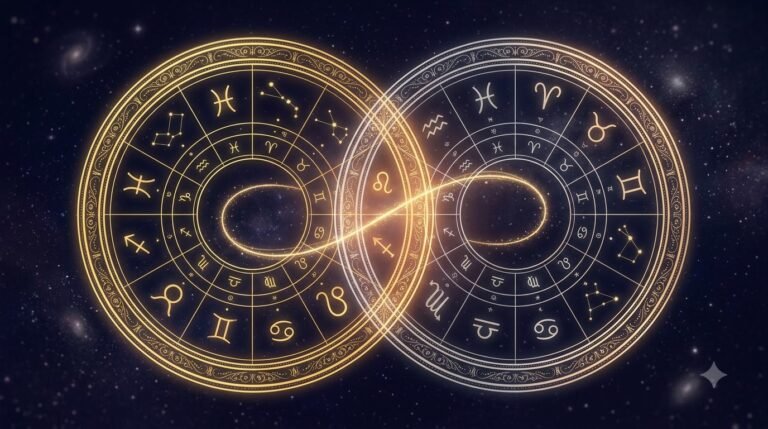
Here is the simplest way to picture it: take two birth charts. Place one on top of the other, so the two zodiac wheels line up. Now look at where each person's planets land — not just in their own chart, but in the other person's chart. That is a synastry chart. Every line, every overlap, every angle between the two sets of planets tells you something about the relationship.
- Your planet in their house: This shows what area of their life you activate. Your Venus in their 7th house = you trigger their partnership energy.
- Their planet on your planet: This shows what their planet awakens in yours. Their Saturn on your Moon = they bring structure — or restriction — to your emotions.
- Their planet on your angle: This is where the relationship leaves a permanent mark — the Ascendant, Descendant, Midheaven, and IC.
- Aspects between the two charts: These are the angles between Person A's planets and Person B's planets. They create flow or friction.
That is the entire framework. Synastry chart explained in one sentence: it is what happens when two birth charts overlap. Everything below is how to read what you see.
The 5 Key Overlays That Matter Most
A full synastry chart has hundreds of data points. But in practice, 5 overlays do 80% of the work. Learn these and you can read almost any relationship — quickly and accurately.
Where each person's Sun lands in the other's chart shows where they light up each other's life. Their Sun in your 5th house = they bring joy and play. Their Sun in your 10th = they inspire your career. This is the "why we are in each other's lives" overlay.
The Moon overlay shows emotional safety. Where your Moon lands in their chart tells you where they feel emotionally held by you. If their Moon sits on your Sun or in your 4th house, the emotional bond is immediate and instinctive. This is the "how we feel" overlay.
Venus — whose cycle is tracked by NASA — rules love and pleasure. When Venus overlays are strong, physical attraction and affection flow naturally. When Venus lands in your 7th house or on your Descendant, romantic chemistry is immediate. This is the "how we love" overlay.
Mars shows drive, desire, and conflict. Where Mars lands in the other's chart tells you where attraction is hottest — and where arguments ignite. Mars on the Sun = passionate but combustible. Mars in the 6th house = motivates the other person to take action. This is the "how we fight and want" overlay.
Saturn shows commitment, structure, and longevity. Where Saturn lands in the other's chart shows where the relationship gets serious — or where it feels heavy. Saturn on the Descendant = long-term partnership potential. Saturn on the Moon = emotional restraint. This is the "how long we last" overlay.
If you only ever look at these 5 overlays, you already know most of what a synastry chart has to say about a relationship. The remaining overlays — Mercury, Jupiter, Uranus, Neptune, Pluto, Chiron, and the Nodes — add nuance and depth.
What Trines, Squares, and Conjunctions Mean in Synastry
Every synastry chart has hundreds of aspects — angles between Person A's planets and Person B's planets. But they fall into four categories. Learn these four categories and you can read any synastry chart, even without knowing the specifics.
Modern relationship psychology — including the framework of attunement and repair — has long recognized that healthy relationships are not about avoiding conflict, but about how two people handle it. Synastry chart aspects describe the same thing: not whether there is friction, but what kind of friction it is.
Two planets sit on top of each other across the two charts. Their energies merge and amplify — sometimes beautifully, sometimes overwhelmingly. Conjunctions are the most powerful synastry aspect.
Natural ease between the two charts. This is where things flow without effort. Trines in synastry are the "we just get each other" aspects — the reason a relationship feels effortless in certain areas.
Friction and tension. Squares show where you trigger each other. Uncomfortable — but this is where growth lives. Relationships with zero squares are often stagnant; relationships with only squares are exhausting.
Direct tension — two planets facing each other. Oppositions in synastry often show up as "I need the opposite of what you give." They push both people toward balance, if they can hold the tension without breaking.
The rule of thumb for synastry chart explained through aspects:
- Trines show where you flow together. These are the reasons the relationship feels easy in certain areas — lean into them.
- Squares show where you trigger each other. These are the growth edges — the exact places you are here to learn patience and compromise.
- Conjunctions show where you merge. Depending on the planets, this is either your strongest bond or your biggest blind spot.
- Oppositions show where you balance each other. This is the yin-yang of the relationship — complementary but often polarizing.
The healthiest synastry charts are not the ones with only trines — those are often boring or codependent. The healthiest charts have a mix: enough trines to feel supported, enough squares to keep growing, and enough oppositions to keep things interesting.
Reading a Real Synastry Chart — A Walk-Through
Here is a real example of synastry chart explained — step by step — so you can see how the layers come together.
Sun overlays. Person A's Leo Sun falls in Person B's 11th house — meaning A activates B's social and community life. Person B's Gemini Sun falls in A's 9th house — meaning B inspires A's growth and travel.
Moon overlays. A's Cancer Moon falls on B's Scorpio Moon (conjunction in water). Deep emotional resonance — they feel each other instantly. But it can get heavy: both feel deeply and neither is naturally light about it.
Venus overlays. A's Venus in Leo falls in B's 12th house — meaning A's love feels slightly hidden or idealized to B. B's Venus in Gemini falls in A's 9th — a light, playful, curious love.
Mars overlays. A's Mars trines B's Mars — same element, easy flow. They rarely clash on how to act. But B's Mars squares A's Sun — a persistent low-level tension between B's drive and A's ego.
Saturn overlays. A's Saturn opposes B's Moon — this is the biggest challenge of the chart. A may unconsciously restrict B's emotional expression, or B may feel disciplined (or criticized) by A.
The full reading: "This relationship has strong emotional depth (Moon-Moon conjunction) and easy action flow (Mars-Mars trine). Socially they are a great pair (Sun in 11th). But A's Saturn opposing B's Moon means the biggest work is emotional — A must not become the "parent" figure, and B must not shut down emotionally in response."
That is the entire process of reading a synastry chart. You do not need to understand every degree and angle. You read the 5 key overlays first, then check the major aspects. That is enough to describe any relationship in real, honest terms.
What Synastry Chart Explained Is NOT
Synastry chart explained gets distorted by a lot of misinformation. Here is what it is not — so you can skip the myths and read the chart properly.
- Not a compatibility score. Synastry does not give a percentage. Any site that does is either simplifying for entertainment, or misunderstanding the tool. Two charts are not "82% compatible" — they interact in specific ways.
- Not a prediction. Synastry cannot tell you whether a relationship will last. It shows you where the flow and friction live — what you do with that is still your choice.
- Not about soulmates. Synastry does not detect "the one." It shows connection patterns. Some of the strongest synastry charts belong to relationships that ended — because intensity is not the same as longevity.
- Not just about Sun signs. Sun-sign compatibility tables are not synastry. Real synastry uses every planet, every angle, and every house overlay — which is why you need exact birth times.
- Not a replacement for the relationship itself. You do not "win" a relationship by having a great synastry chart. You win it by showing up. The chart is a map, not the journey.
Once you strip away the myths, synastry chart explained becomes one of the clearest, most honest tools in astrology. It does not tell you what to do. It tells you what you are working with.
How to Actually Use a Synastry Chart
Learning synastry chart explained is useless if you do not apply it. Here is how to use it in real life — without turning the relationship into an astrology experiment.
- Read the 5 key overlays first. Sun, Moon, Venus, Mars, Saturn. If those tell a coherent story, you already understand the relationship. Do not drown in data.
- Look for Venus-Mars connections. These are the attraction and desire lines. Trines or conjunctions mean natural chemistry. Squares mean hot-and-cold.
- Look for Saturn contacts. Saturn on the Descendant or 7th house = long-term potential. Saturn on the Sun or Moon = heaviness or responsibility. These tell you whether the relationship is built to last — and how much work it will take.
- Do not treat squares as dealbreakers. Squares are where the relationship grows. Relationships without friction often flatline. The right squares keep a relationship alive.
- Check the composite chart next. Synastry is about how two people interact. The composite chart (the midpoint chart) is about the relationship itself — its own personality. Together, they give the full picture.
- Use it to understand, not to judge. Synastry charts do not decide whether to stay or go. They help you see the relationship clearly. The choice is still yours.
The best way to learn synastry is to read your own relationships — past, present, and the ones that changed you. Run the chart with a partner, an ex, a sibling, a parent. Patterns will emerge quickly. That is how synastry chart explained becomes real.
Want the full picture? Our Birth Chart Calculator gives you your individual chart first — the foundation you need before reading any synastry.
Frequently Asked Questions
Real questions, straight answers. No fluff.
A synastry chart is two birth charts placed on top of each other to see how they interact. Each person's planets land on the other person's planets, signs, and houses — showing where the relationship flows, where it struggles, and where it transforms.
No. Synastry does not give a percentage. It is a map — showing where the relationship is easy, where it is electric, and where it is work. Compatibility scores are a marketing simplification, not real synastry.
Yes — for both people. Without exact birth times, you cannot calculate either Ascendant, either house system, or either chart's angles. That makes most of the synastry chart unreadable. Request missing birth times from the state vital records office if needed.
Synastry compares two charts — how two people interact. Composite creates a new chart from the midpoints of the two — the relationship's own personality. They complement each other: synastry shows the interaction; composite shows the relationship itself.
The 5 key overlays are Sun, Moon, Venus, Mars, and Saturn. Sun = why you are in each other's lives. Moon = emotional safety. Venus = love and affection. Mars = desire and conflict. Saturn = commitment and longevity. Together they describe 80% of a synastry chart.
No. Squares create friction — but they also create growth. Relationships with only trines are often stagnant; relationships with only squares are exhausting. The healthiest charts have a mix. Squares show where the relationship has to work — and where it can grow.
No. Synastry shows where the flow and friction live — but it does not predict outcomes. Strong synastry charts sometimes belong to relationships that end. Weak charts sometimes belong to lifelong partnerships. The chart is a map, not a fortune cookie.
Saturn on your Moon is one of the heaviest synastry contacts. It can mean emotional restriction — you may feel criticized, controlled, or held back. But it can also mean emotional commitment — a stable, protective bond that matures over time. The tone depends on the rest of the chart.
No. Synastry applies to any two people — romantic partners, friendships, family members, business partners, even colleagues. Any relationship between two people can be read through synastry. The overlays mean the same thing regardless of the relationship type — they just express differently.
Start with the 5 key overlays (Sun, Moon, Venus, Mars, Saturn). Then look at the tightest aspects — the ones within 3 degrees. Those are the loudest. Do not try to read all 200+ aspects at once. A synastry chart explained properly starts with the loudest voices.
Synastry Chart Explained — The Short Version
Synastry chart explained in one line: two birth charts placed on top of each other. Read the 5 key overlays first — Sun, Moon, Venus, Mars, Saturn. Then read the tightest aspects. That is enough to describe almost any relationship honestly.
Synastry is not a compatibility score. It is not a prediction. It is not a soulmate detector. It is a map — showing where the connection flows, where it burns, and where it has to work. What you do with that map is still your choice.
Read your own charts first. Then read the charts of the people you love. Synastry chart reading is not memorization — it is attention. Once you know where to look, you see relationships more clearly than you ever did before.

Written by the Zodiac Magic Team
Astrology researchers and writers since 2020. Our guides combine traditional Western astrology with modern psychological frameworks — including attachment theory, Jungian archetypes, and evidence-based relationship research. We also build 35+ free astrology tools used by thousands of readers every month. Read our editorial policy →
More Cosmic Tools To Explore
Free calculators that pair perfectly with this tool — no signup, no paywall.
Send this to the friend who needs it
If you love astrology, you'll enjoy this one! It reveals some interesting things about your zodiac sign that you might not know.
You May Also Love To Read
More astrology guides from Zodiac Magic — picked for you.
 Astrology Guides
Synastry Chart Explained: Relationship Astrology Guide
Synastry chart explained without fluff. What synastry actually is, the 5 key overlays, and how to read relationship…
Read article Astrology Guides
How to Read Birth Chart: Beginner’s Guide to Astrology
How to read birth chart explained in 7 layers — no fluff. From the wheel to the aspects,…
Read article Astrology Guides
What Is the Vertex in Astrology? And Why It Changes Everything
Vertex in astrology explained without fluff. What your Vertex actually says about fate, fated encounters, and where destiny…
Read article Astrology Guides
What Is My Part of Fortune? How to Find It in 3 Minutes
How to find part of fortune explained in 5 steps. The formula, the signs, the houses, and how…
Read article Astrology Guides
North Node Meaning: Where Your Soul Is Going (Not Where It’s Been)
North node meaning explained without fluff. Your North Node describes the direction your soul is meant to grow…
Read articleGet New Tools & Cosmic Insights Before Anyone Else
New astrology tools, free guides, and monthly cosmic insights — delivered straight to your inbox. No spam. Unsubscribe anytime.